Fax vs Email: Which Is Actually More Secure?
Ask a cybersecurity expert whether fax or email is more secure, and you'll get a frustrating answer: "It depends." Both have strengths and weaknesses, and the real answer depends on how each is implemented. Let's cut through the noise.
How Traditional Fax Security Works
A traditional fax machine sends data through the Public Switched Telephone Network (PSTN). The document is scanned, converted into audio tones, and transmitted point-to-point over a dedicated phone line.
From a security standpoint, this means:
- No intermediate servers — The data goes directly from sender to receiver.
- Difficult to intercept — Tapping a phone line requires physical access and specialized equipment.
- No storage in transit — The data isn't cached or stored on servers along the way.
That's why industries like healthcare and finance have historically trusted fax. It's a closed system with a clear chain of custody.
Where Fax Falls Short
Despite its point-to-point advantage, traditional fax has real security gaps:
- Exposed output — The printed fax sits in an open tray. Anyone walking by can read it.
- Wrong number risk — A single misdialed digit sends your confidential document to a stranger.
- No encryption — Traditional fax transmissions are not encrypted. They're sent as raw audio signals.
- No authentication — There's no way to verify who picked up the received fax.
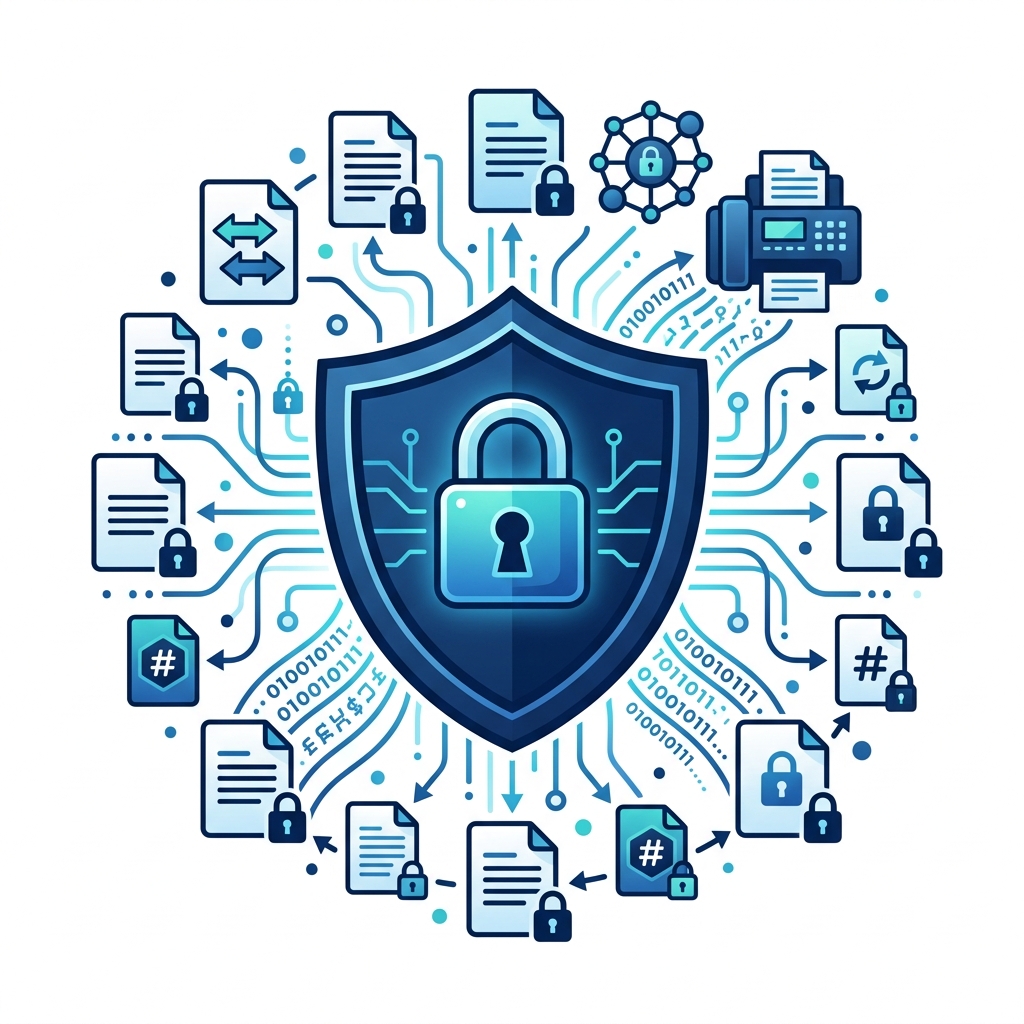
Modern security requires encryption at every stage — something traditional fax doesn't provide.
How Email Security Works
Email relies on a chain of servers to deliver messages. A standard email bounces through multiple servers before reaching the recipient's inbox.
- TLS encryption — Most modern email providers use TLS to encrypt data in transit between servers.
- End-to-end encryption — Services like ProtonMail offer E2EE, where even the provider can't read your emails.
- Multi-factor authentication — Adds a layer of identity verification.
- Spam and phishing filters — Catch many malicious attempts before they reach your inbox.
Where Email Falls Short
- Server vulnerability — Emails are stored on servers that can be hacked. Major breaches happen regularly.
- Phishing attacks — Sophisticated phishing emails trick users into revealing credentials.
- Metadata exposure — Even with encryption, metadata (who sent what, when) is often visible.
- Forwarding risk — An email can be forwarded to anyone, losing control of the document.
Security Comparison Table
| Factor | Traditional Fax | Email (Standard) | Email (E2EE) |
|---|---|---|---|
| Encryption in transit | ❌ None | ✅ TLS | ✅ Full E2EE |
| Intermediate servers | ✅ None | ❌ Multiple | ❌ Multiple |
| Interception difficulty | High | Medium | Very High |
| Authentication | ❌ None | ✅ MFA | ✅ MFA + keys |
| Compliance (HIPAA) | ✅ Accepted | ⚠️ Conditional | ✅ Accepted |
| Physical exposure | ❌ Tray risk | ✅ None | ✅ None |
What About Online Fax?
Online fax sits between the two. It uses the internet for transmission but connects to the phone network for the last mile. The best online fax services add:
- 256-bit AES encryption for stored documents
- TLS encryption during transmission
- HIPAA compliance certifications
- Access controls and audit logs
This makes online fax potentially more secure than both traditional fax and standard email for regulated industries.
Important: Not all online fax services are equal. Some budget providers skip encryption altogether. Always check for SOC 2 compliance and HIPAA BAA availability if you handle sensitive data.
The Verdict
There's no universal winner. Here's the practical advice:
- For HIPAA-regulated documents — Use online fax with a HIPAA-compliant provider, or email with E2EE.
- For general business — Standard email with TLS is typically fine.
- For one-off sensitive documents — Online fax with encryption is the safest quick option.
- Avoid — Unencrypted traditional fax for anything truly sensitive.
The days of "fax is always more secure" are over. What matters now is the specific implementation — not the medium itself.