Is Online Fax Secure? What You Need to Know
You're considering switching to online fax, but you handle sensitive data — patient records, legal contracts, financial documents. The question isn't "is online fax convenient?" (it clearly is). The question is: "Is it safe enough?"
The short answer: it depends entirely on the provider. Here's how to evaluate security.
How Online Fax Handles Your Data
When you send an online fax, your document goes through several stages:
- Upload — Your document travels from your device to the provider's servers
- Storage — The document is temporarily or permanently stored on their servers
- Transmission — The document is converted and sent to the recipient's fax number
- Delivery — The receiving fax machine prints it, or (if the recipient also uses online fax) it arrives digitally
- Archival — The sent fax is stored in your account history
Security vulnerabilities can exist at every stage. A good provider secures all of them.
Encryption: The Non-Negotiable
In Transit
Your document should be encrypted during upload (from your device to the server) and during delivery. The standard is TLS 1.2 or higher. This is the same encryption used by banks and e-commerce sites.
At Rest
Once your document sits on the provider's servers, it should be encrypted with AES-256 — the same standard the US government uses for classified information. Without at-rest encryption, a server breach exposes your documents in plain text.
Red flag: If a provider doesn't mention encryption in their security documentation, assume they don't have it. Move on.
HIPAA Compliance
If you handle Protected Health Information (PHI), HIPAA compliance is mandatory. Here's what that means for your fax provider:
- Business Associate Agreement (BAA) — The provider must sign a BAA with you. This is a legal contract making them responsible for protecting your data.
- Access controls — Only authorized users can view faxes
- Audit trails — Every access, send, and receive is logged with timestamps
- Data retention policies — You can set how long documents are stored and when they're automatically deleted
Not every online fax provider offers HIPAA compliance. Comparison resources like FaxRadar clearly indicate which services are HIPAA-ready, which is helpful when narrowing down options for healthcare use.
SOC 2 Certification
SOC 2 (Service Organization Control 2) is an auditing standard that verifies a company's security practices. A SOC 2 Type II certification means the provider has been independently audited over a period of time (usually 6–12 months) and meets standards for:
- Security
- Availability
- Processing integrity
- Confidentiality
- Privacy
SOC 2 certification isn't legally required, but it's a strong trust signal. It means the provider takes security seriously enough to undergo expensive third-party audits.
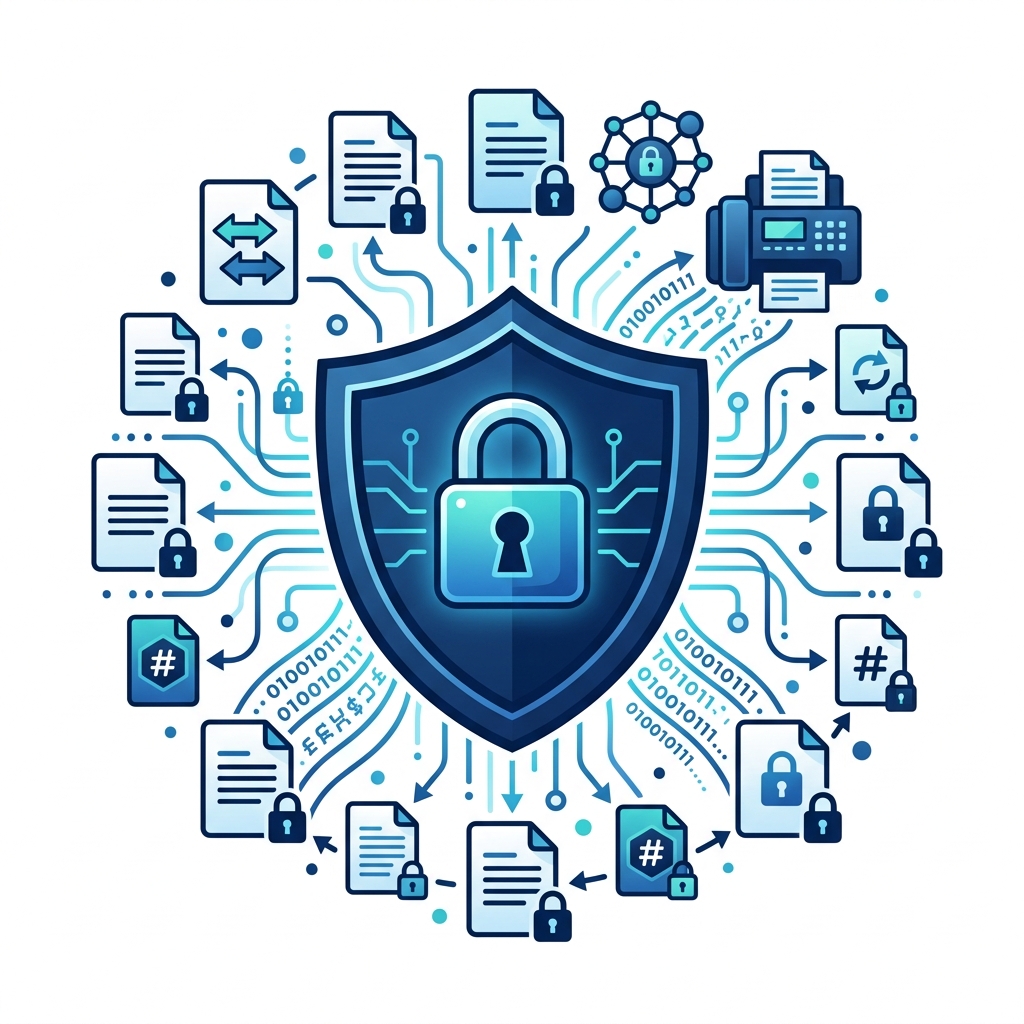
A secure online fax provider protects your documents at every stage — upload, storage, transmission, and archival.
Security Checklist for Choosing a Provider
| Feature | Must Have | Nice to Have |
|---|---|---|
| TLS 1.2+ in transit | ✅ | |
| AES-256 at rest | ✅ | |
| BAA available | ✅ (healthcare) | ✅ (other) |
| SOC 2 Type II | ✅ | |
| Two-factor authentication | ✅ | |
| Auto-delete after X days | ✅ | |
| IP whitelisting | ✅ | |
| Audit logs | ✅ (regulated) | ✅ |
Common Mistakes
- Using free services for sensitive data — Free providers rarely offer encryption or compliance features. Never send PHI, SSNs, or financial data through a free fax service.
- Sharing login credentials — Each user should have their own account with unique credentials and 2FA.
- Ignoring the "last mile" — Even with perfect end-to-end encryption, if the recipient has a physical fax machine, the printed document sits in an open tray.
The Bottom Line
Online fax can be very secure — but only if you choose a provider that prioritizes security. Look for TLS encryption, AES-256 at rest, HIPAA compliance (if needed), and SOC 2 certification. Don't cut corners on a free service when you're handling sensitive documents.